Do you think Shakespeare ever swatted away a fly while writing?
I have. Just did, actually, as I typed out that sentence.
Not to compare myself to the bard but it would bring me comfort to know that great writers have also had / also have to deal with these pesky, banausic details of life. Has de Beauvoir done the same? Brought her hand across the Parisian air knowing the possibility of success is proche de zéro? I’d ask the same of Wilde but he probably saw the fly as a metaphoric vessel for some kind of political stance.
Anyway, a fly meanders its way across my desk is the point I am trying to make. And I’ve seen this film a hundred times, played this game a million times to know that I stand no chance of victory against this creature of a thousand lenses. Still, I try my hand at smiting the little guy. The result is, of course, a deafening defeat for me. Somewhere in the distant sun, the god who looks after smaller things is entertained.
I am now contemplating the reason for this adversarial behavior of mine against something that is simply doing what it was born to do. Perhaps it stems from the fact that the fly’s flying around my desk is hindering me from doing what I’m born to do. But, if I’m being honest (as most writers infrequently are), perhaps I’m occupying myself with the fly to keep from actually having to write.
There is no suffering quite like that of the writer. There is no agony quite like that of the writer attempting to write about writing. Indeed, all art forms languish in different ways; the writer risks their words being translated incompetently or worse incompletely, the artist risks the decay of their paints with every sunrise, the musician struggles to hold the listener’s attention after the final note has been struck. As one who has chosen words as her medium, it is no wonder I harbor some degree of bias. Woe is me! and all that, though it is by preference that I have landed myself in front of this pastime, as paintbrushes refuse to behave in my grasp and I cannot bear the arduous task of sight reading sheet music.
The constraint of twenty-six English alphabets does not appear friendly to me and, now, some computer-generated text threatens to diminish the very power of the em dash. Well, look at me—using it so freely! Perhaps—even using it wrongly! The beauty of humans over machines is that we have the freedom to make mistakes—intentionally. The freedom to swat at flies despite the odds being stacked against us. Even more beautiful is the fact that there is a story behind every sentence I string together, every line break I enter.
Back to the fly.
It remains buzzing around me—though, more in energy than in audible sound, for which I am grateful. I wonder if it has fixated on my desk in a way to observe my writing, as if to say it will go away once this essay has reached completion. What is the intelligence level of flies? Can they read? Why have thousands of lenses and more than two eyes if you won’t use them for reading? Certainly, that is what I would use such features for! To read multiple books at once!
Or, maybe, the fly is taunting me. The more I think about it (which, frankly, didn’t take very long), the more I am resolute in my belief that the art of writing is akin to the art of fly swatting. Indeed, all artists suffer in different ways; the chief source of suffering for the writer is always coming close but never truly close enough to encapsulate what is, in the same way we can come very close to hitting a fly with our hands, but it narrowly escapes death by constantly slipping through our fingers. We can tell you what was and what might be, but I am a solemn pledge to the idea that writing can never quite fully capture what exists in the moment. The moment is always changing. The fly’s route is never predictable.
Often, I find myself rather limited by my words, particularly during noonish hours when the air is dry and it is too late for another cup of coffee and the hum of my fan seems to be playing to a crescendo. There are some things that simply cannot be conveyed in its entirety through the written word.
Let me put the space between my furrowed brows next to your temple so you recognize just how much I worry. About the things I can change and the things I cannot change. So you see how serenity exists on paper but not quite within my mind.
Give me peace in a haiku and I’ll show you desperation in a sonnet. Though a sonnet cannot cry tears like I do, cannot fill rivers like I do, cannot overflow fountains like I do. I’ll do better than fourteen lines, I’ll give you fourteen lives. In the octave, I’ll ask you how you could forgive me; in the sestet, I will have to break your heart.
And while love letters I have written a-plenty, my love does not awaken in the words I have penned, rather in the line breaks I have dictated. I long to put my beating heart in your cracked hands and say, Look, feel this. Feel what I cannot write. Let this rhythm sync up to your own pulse and let us communicate in a morse code variant that shan’t be translated, shan’t be understood, only felt.
You might think beginnings live in capital letters (preferably serif), and you would be wrong. Beginnings rev their engines in full stops, chart their courses in one miniscule dot. You put a vertical line under that dot and you have the protagonist of your beginning. You put a vertical line above that dot and you have a child walking for the very first time, full of color and sound. You put another dot above that initial dot and you can say something. Anything! Let there be light? Let there be speech!
Look, at how your mother’s rocking hands are shaped like a comma. I’m only sorry I cannot recreate the concurrent lightness and heaviness of her rocking through words. Think about her penmanship on her grocery list, her non-stop nagging out of care, and the remnants of the watermelon slice she has cut for you. She gave you your beginning then added a little more. A mother exists in every comma, knowing no ends.
Here, take this em dash and get off your artificially generated high horse. Learn how to use it. Leverage it. Sleep with it like a log. Wield it like a weapon of resistance. Recognize that if you tilt it in varying angles, it will survive in every language. But, oh, what a disappointment it is when you burn it like a bridge only you have crossed, getting back on your artificially generated high horse that doesn’t look quite right. I don’t see how my words can save you then.
The fly has just come back, perched on the top of my monitor, inviting my hand for an unfair high five. Instead, I offer it a staring contest. I lose too quickly. It flies away and I still haven’t quite captured what I wanted to express.
The best thing about writing, I’ve come to learn, is realizing what cannot be written. Writing is an attempt to understand the world. But the world wasn’t made for understanding in the first place. It is for living. The fly knows this. I know this but refuse to believe the two cannot coexist. I am nothing if not stubborn. I will try my hand again and again at swatting this fly, at writing this life.
SUBSCRIBE TO BE NOTIFIED OF NEW WRITING
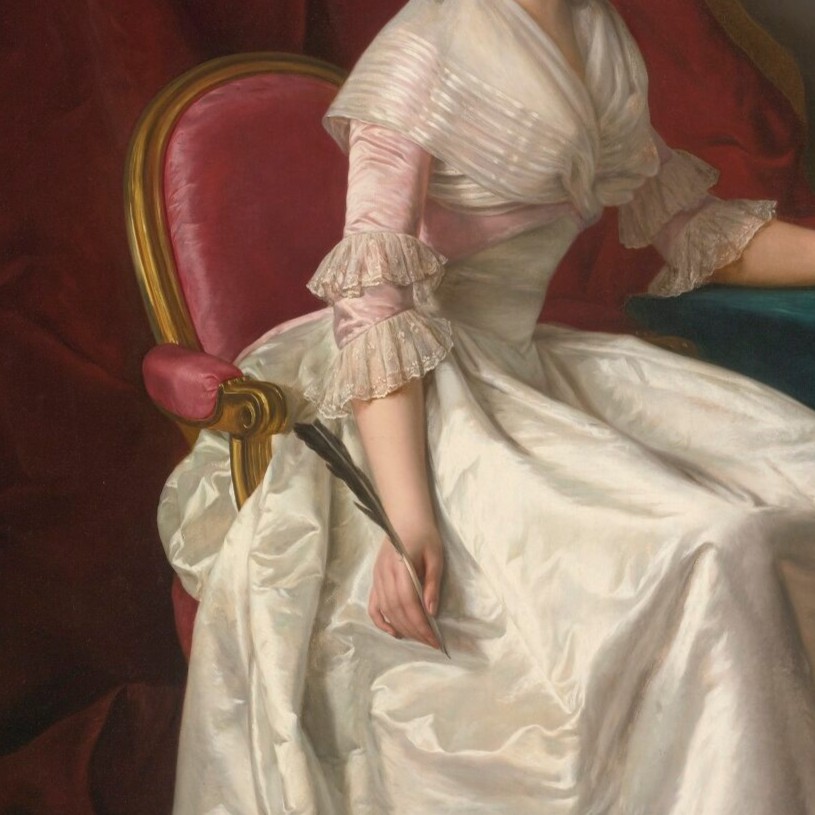
The accompanying image (Portrait Of A Lady by Rose-Adélaïde Ducreux) serves only as a visual complement to the essay and carries no interpretive or illustrative claim beyond that.


Leave a Reply