It is entirely unnecessary for me to put shovel to ground, for the earth opens up naturally to receive her. Beneath balding branches and final glistens of summer’s light, her face is pale like uninked parchment. Yet, layers of black cascade down the folds of her body; ink or cloth—who’s to say? I lay her gently unto soil like yielding a delicate but exhausted babe to a crib. I do it the way one buries a seed—not to discard, but to transform. Above, the sky shudders and the leaves rustle in agreement with my action. No rain meets the ground; this is not a mourning occasion.
As the last speck of dirt covers her fully, neither grief nor fear is suspended in the air, only the quiet truth that, to evolve, one must first die in some small way. One must trust the earth, really. The earth will strip her down to her bare bones. Discard the metaphors imprinted on her fingertips. Erase the allegories nestled in the crook of her neck. Expunge the imageries embroidered to the inside of her eyelids. For her rhythms have long since found solace in her veins, and she found a comfortable home in the unknown. Being exposed too long above the surface wears one down; the relentless tug of creation—the need to consume and regurgitate in an original form is a kind of disease. She has labored over letters and now they are all spent, and to hold on to them would be to deny the possibility of the new. If the leaves do not fall from the trees this season, we shall witness no fresh bloom next spring.
Hark! In the silence, she will learn to sit with the fertile chaos from which true creation springs. Her thoughts, truths, prose, and lies decompose slowly, returning to the ground from which they came. A nasty process, it is. She decays in the deep quiet of the ground—not in ruin, but in rebirth.
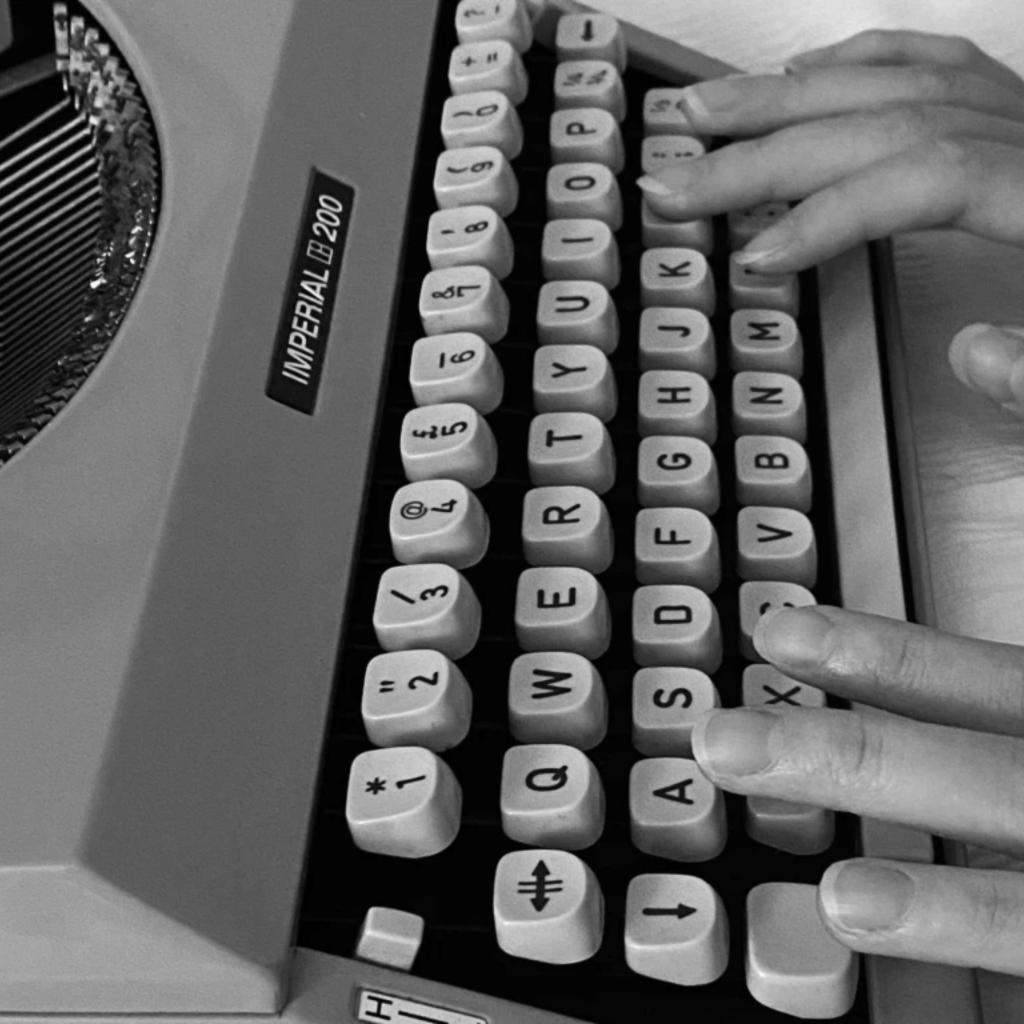
I bury the poet to nourish her—the kind of nourishment only the solitude of darkness can provide. I do not bury her typewriter with her; instead, I place it square on the ground where the weeds propagate lest she forgets the weight of words. I bother not with carving a name into her headstone for she knows not who she is; she has spent a lifetime walking in the shoes of others, trying to absorb their pain and liquefy them into alphabets.
Periodically, I buy her wilting bouquets so she can try to extract some beauty from them. Just because she is convalescing does not mean she can’t continue the practice of making something dying look pretty. I desecrate her grave so she knows someone, too, is willing to write for her—sin for her. I do not sprinkle a circle of salt around her grave but, instead, lodge grains beneath her nail beds so the world is protected from the wrath of her vitriolic words. So she might cleanse herself of past words and worlds. We are temporarily free from her alphabetical torment! But beware! She shall return with more scorn!
There is no remorse. Seasons turn, so too must the mind. There are fallow periods where nothing grows. It is in death that there is life. It is in emptiness that new ideas spring. I bury the poet because sometimes, to create, one must first learn how to let go. And if she refuses to do so herself, she has then forced my hand.
When the moon is ripe, she will draw breath and claw her way back to the surface, the earth embedded in every hollow of her anatomy. She claws—not gently, but with the fierceness of a shoot breaking through stone—having tasted absolute death and coming back to tell the tale.
It is not a resurrection when she rises—a resurrection indicates the recovery of the old. The poet is dead! Long live the poet! She is rebirthed in the rawest form. I hand her the sharpest pen known to man. I let her get to work as the first drop of rain meets the earth.


Leave a Reply