Measurements exist to keep us, the living, at ease. There is solace in knowing exactly how many kilometers you’ve travelled, how many hours you’ve logged at work, how many liters of water you’ve consumed today. Measurements exist alongside the concept of “enough”. There is a point of sufficiency, of acceptance, of congratulations. That point is unknown to me. “Enough” is a conditional mercy, popping by the party only when everything has been incinerated. Maybe less congratulations, more consolation prize (and, yes, there is a stark difference between the two).
Other children were measured in centimeters against their doorframes, the pencil marks fading but prevailing; I was measured in sighs and head shakes, each one seemingly longer and quieter than the last. I was told excellence would save me, so I learned early to pre-apologize for what would be failures. I ran not knowing where the finish line would be. I clapped for myself silently because the room would always just stare back in inaction. I learned that “enough” didn’t exist for me—that, or it kept moving out of reach, telling the goalpost and yardstick not to recognize my face and only my silhouette. Which is worse, I have yet to learn.
Someone once asked me why I learned so many languages. It’s so that one day I will be listened to. Someone once asked me why I throw myself at various art forms. It’s so that one day I will be seen. Someone once asked me why I read like the page will disappear. It’s because I am trying to find someone who is exactly like me. But that all amounts to a graveyard of lies: I do it all hoping someone will tell me they are proud of me.
So I am all at once Icarus, Sisyphus, and Atlas. Only I fall faster than, push heavier than, and hold more than all three. Respite is a concept unknown to me. I swallow the vile mixture of sweat and tears that have presented themselves next to my thirsting tongue and I keep going. I thirst to be enough. I thirst for a greater being to hold the goalposts and yardsticks down by force and shackle them to the ground so that I might run up to them and inscribe my name in blood. But after years of thirsting, there is clarity: Whoever this greater being might be, they do not listen to me because the people around me have already chosen not to listen. They learn to forsake by observing where I fall on everyone else’s measures. It is so that I find myself before flames instead of pearls, and dare I say what is warm feels more like home than what is pure.
They say the road to hell is paved with good intentions but my road to hell is a museum of trying. Hell is less inferno and more accounting. There is a ledger, and markers on that ledger. Both precise, both objective, both unmoving. This is where there can be no asks of me to be more than I am. Where “more” loses its meaning. Where I have nothing left to offer but my existence. Where I am no longer compared to the poster child next door because the entire neighborhood has been engulfed in flames—a color, a symphony so delightful as it waltzes on your skin and feasts through your bones. Hell is where nothing is asked of me except survival, and I have always been good at that. Excellent at that.
I’m finally enough when in hell. Only enough when in hell.
This place does not check my potential at the door or demand quantifiable growth within quantifiable timelines. It does not mock me with the person I could have been. It embraces the version of me sans utility and can find no reason to reject me. Worth stops being a moving target. It stops being a target at all. It becomes innate and unceremonious. Just like breathing. I could be without becoming impressive.
Hell is honest. It doesn’t pretend to save me through baptism by fire. It simply lets me be. And this is what nobody wants to hear: That I didn’t find myself by becoming enough and then some; I found myself by becoming someone no one could understand or use. When the excellence is flayed away, there is still a body that breathes, a consciousness that blooms, something unremarkable but undeniable saying here I am, as I am.
When the flames die down and all that is left are the ashes, do not expect them to arrange into an apology. Do not weep for me with both your feet on solid earth. I walked in here of my own volition. But you were the one who paved the road.
SUBSCRIBE TO BE NOTIFIED OF NEW WRITING
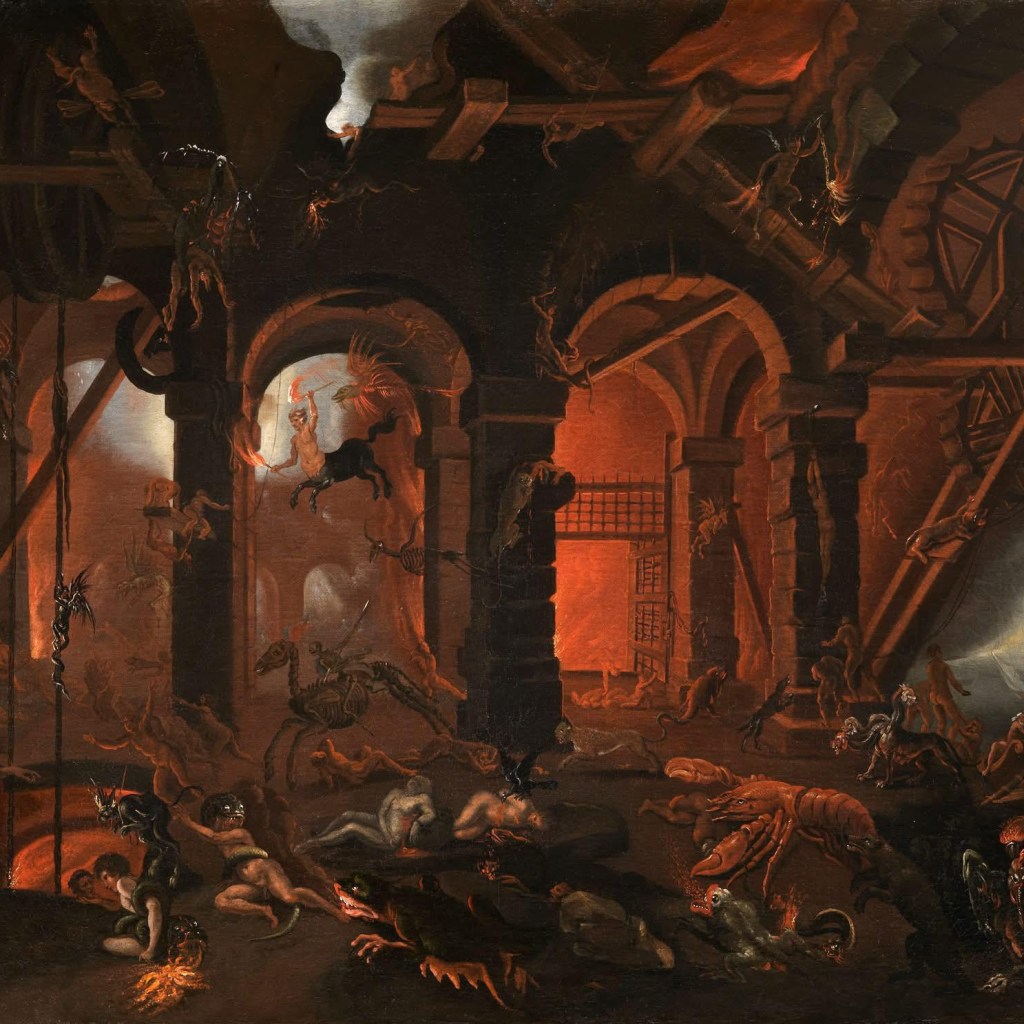
The accompanying image (Dante and Virgil in Hell by Filippo Napoletano, 1622) serves only as a visual complement to the essay and carries no interpretive or illustrative claim beyond that.
 Allison's Archives
Leave a comment