The year that succeeds one’s university graduation is particularly damning; three years of structure, syllabi, and social calendars dissolve into precarity. I find myself perplexed by the lack of discussion around these three hundred and sixty-five days; why do we not lend to it the same ceremony as we do moving abroad, being broken up with, purchasing a home, experiencing a close one’s death, or getting married? I wonder if I had missed the memo for the collective agreement that this would be a year in our lives we silence by default, if there is some kind of merit in figuring out life after graduation in solitude. Whatever the consensus, there is this delicious ache inside of me that longs to write about that period.
Under last year’s high-hanging July sun, my parents had fit their suitcases in a Tetris manner into the back of an Uber and bid me good luck in an embrace before clambering into the cab. I was lucky that it didn’t rain on my graduation day, but as the Uber departed to be a smaller and smaller dot, I felt a storm cloud gather above my head. As fiercely as I had fought with my parents to stay abroad without the promise of a job to live out my post-university life, doffing the cap had promptly brought about the fear that I had suppressed all along. Counting the blessings from my parents, I walked back to my flat—cap and gown in tow—and arranged the bouquets I had received while working through a slow-gnawing panic. Sure, the world was my oyster now, but I hadn’t yet figured out how to pry it open without slicing my palm.
I have gathered that there are three main pillars of life after graduation: Employment, passion, and relationships. Each pillar is, of course, adorned with further embellishments, the details of which become more applause-worthy the more you work at it like a sculptor—for the pillar of employment, financial stability and work-life balance; for passion, adventure and fulfilment; for relationships, platonic, romantic, and familial; and so on. Safe to say that there can be more pillars accounting for individual preferences and circumstances, but these three tend to be scrutinized under a magnifying glass more often than others. My qualm upon graduation was the progressive and simultaneous building of all three pillars; you see, it isn’t enough to just form the foundations and maintain the pillars as they are—the true mark of success in the culture and environment I was brought up in is the continuous work to punctuate your pillars with as much detail as possible. Bring on the Corinthian-style acanthus leaves and scrolls! Who wants to leave behind a legacy of pillars that look exactly like those of their neighbor’s?
Let’s begin with employment, then, for without it, one is largely discouraged from diverting attention toward the columns of passion and relationships. Simply put, lacking a steady income stream induces the dreadful worry of making ends meet, and how would one go about dedicating themselves to their passion or sustaining their relationships while being racked by such distress?
Call it good fortune that I managed to walk into an office to report for my first day of work just three weeks after graduation. The interview opportunity arrived a swift two days after my convocation, and the job offer the very same evening. Everything from my responsibilities to the office and my colleagues was all I had ever dreamed of, yet I couldn’t outrun the ghost telling me that I don’t deserve this. A close friend constantly reminds me that it wasn’t pure luck that the position was mine, that I had put in the legwork necessary to get to where I am. Still, I couldn’t help but wonder why the same fortune was not prescribed to my peers who worked just as hard as I did, if not harder.
Some who decided to stay abroad struggle with dire job market prospects, while many of those who buckled into a home-bound flight are now working into unholy hours of the night without personal reprieve. The disparity was glaring—between friends who are buoyant with promotions and those who send out hundreds of applications into the void, between friends who graduated from late nights at the library to late nights in the office—but what was there for me to do except to let my gratitude gasp for air at frequent intervals?
Could this be the cruelty of the first year after graduation? Employment masquerading as a personal triumph when it is often a lottery dressed in merit? To acknowledge the role of luck feels like mutiny to the efforts we have put in, and yet to deny it feels dismissive of those in wait, those who are still hustling. We are all taught to swallow the hypocrisy that jobs are earned, that hard work translates perfectly into opportunity, and that the market rewards perseverance and intelligence. But the less palatable truth is that timing, geography, and networks carry just as much weight. If the concept of employment is framed solely as the fruit of personal effort, then those left outside the orchard must be undeserving—this ideology spares the skewed system from scrutiny while turning fellow graduates into cautionary tales. The scarcity of opportunity becomes natural law rather than a manufactured design, and the gratitude of those who made it, in turn, upholds that narrative. What stings the most is that as much as we can criticize the structure, most of us still require employment to see tomorrow, and so we keep our heads down and work in silence—the only thing we share.
Those of us who managed to secure a job that grants us some semblance of balance progress to pursuing our passions—the things we would be caught doing twenty-four seven if the demands of self-preservation and capitalism were to vaporize. Yet it’s not as simple as having a mere hobby to fill idle moments. No. It seems declaring to the world that you have a passion is tantamount to the promise of dedicating your life outside of work to practising your craft, to become better at it every time you raise it as a topic at a dinner table or an unasked-for street run-in.
What should be a gratifying exploration quickly metamorphosizes into performance. The once private endeavor of passion is now renamed as a side hustle. What good is your passion if it yields nothing apart from happiness? Because how dare we rest on our laurels? We take stock of metrics while silently competing with peers and strangers. We blur the line between self-expression and self-promotion until there is no telling whether the craft is for our enjoyment or for the judgment of an imaginary audience watching from the wings.
Leisure now demands receipts, and as much as I find the idea ludicrous, I catch myself playing along: The guilt festers in my stomach when my inkwell runs dry for weeks. I glance at my un-updated blog and wonder if I have finally run out of words, if I can no longer claim writing as a passion. The silence rings the bells of failure for whole villages to hear, and I hang my head in shame. But if passion only has value when it supplements your income or shows constant progress, how is it different from full-time employment? Passion is not the thing that enables you to live your life, it is you living your life—translating the world into your perspective through a medium of your choosing. Passion is messy, indulgent, and even sinful at least. The truest form of devotion and passion is not constant performance (unless you have dreams of becoming an actor), but the courage to love a thing purely because it wakes you up, all reason out the window.
Enough about passion, let’s talk about relationships. In the past year, I have witnessed—via the internet—four of my peers get engaged. That is an astounding number, particularly when I take into account that I am not yet twenty-four years old. In our mid-twenties, there is this compelling force to keep our relationships close and afloat before they begin to thin out in our thirties—the average period when most people begin to grow their families and take their careers further, which exacts the sacrifice of time. Even more demanding, we are expected to maintain all types of relationships well.
My platonic friendships have seen a seismic shift in the past year, what with friends relocating geographically and being in different stages of their lives. Some have decided to take their higher education to the next level, some have launched their own businesses, and some are cruising the world until they find their footing. This scattering brings about hurdles like time zones and schedule compatibilities to overcome; conversations that once flowed effortlessly over dinner now require excessive planning to accomplish, text chains that once saw non-stop and instant replies now took days to reach conclusions. I can’t help but feel like there’s something to be mourned. I can’t wrap my finger around the very moment it all stopped being easy.
I have also felt the pressure to curate a “core crew” of friends in my city of residence; more specifically, a girl group, a network that is unwavering in its support, ready to race to my flat whenever a crisis arises. While I have successfully found my group of friends, I find myself having to put in more conscious effort to meet up and check in compared to my undergraduate days. I suppose what I’m getting at is that there seems to have been a shift in the way I fundamentally approach friendships. When you cease seeing each other in classes and student council meetings on a weekly basis, the burden shifts onto you to weave that “coincidence” of time and space to keep each other in your orbits—yet another expectation to add to your ever-growing list.
The spectrum of romantic experiences among my peers is dizzying and puts fairytale endings to shame. Some are caught in the infinite swiping loop on dating apps, others surface on social media with an engagement ring photo without prior warning, and then there are those who wrestle with the commitments of long distances. I can’t help but want to ask those who are in long-term, healthy relationships for a cheat code. Is there a manual that was unevenly distributed to my peer group upon graduation? Why are we not all entitled to the same kind of fulfilling and supportive love? Under what moon do I have to be born to meet the love of my life in high school? What brand of cereal should I have for breakfast to be treated the way I deserve? What prompt do I put on Hinge so I don’t end up on a date with a serial killer? Which seat should I pick in a cafe so I don’t end up mothering someone else’s son? So many questions, yet love is the kind of thing that you have to trudge through rather than go around to reach a satisfactory ending. You will have to bear a fair share of embarrassing crushes and go on a few comically boring dates before you find the one—more accurately, before you find yourself.
Familial ties, then, though most stable and permanent in theory, are what I struggle with the most. I have moved away from home for four whole years now, but the absence of my parents and brother continues to ricochet around my room, growing in magnitude. When my mind isn’t occupied by work, I find myself fraught with longing and guilt; watching your family age from afar is an unsettling experience. Days tend to amble by so sneakily that it can be easy to forget that I am, in fact, missing out on birthdays and domestic life with them. While I can construct a new friend group in any given location, the same flexibility is not extended to family. I am torn between the excitement of being abroad, free to pry as many oysters as I want in my mid-twenties, and wanting to follow my mother in her car as she runs errands, to discuss the latest politics with my father on the same couch, and to share a sweet treat with my brother after meals. I keep reassuring myself that this oyster prying abroad is only temporary, but I don’t think I believe myself at all.
Each relationship requires its own version and volume of attention, yet none yields easily. If there is one thing that has become apparent, it is that while the relationships of our younger days can be taken for granted to a certain extent—seeing your classmates five days of the week, having dinner with your family—adulthood asks for conscious effort in exchange. The price of growing up is showing that you care enough to put others above yourself. To set aside your weekend to reply to that message and dial that call. And hope that they miss you the same way you miss them.
After all this discussion, I have to be truthful. I’m still slicing my palm open while prying oysters. I haven’t gotten it all figured out. The mystery year after graduation still baffles me and I wish more people talked about finding their footing, buttressing their pillars, and prying oysters. For now, all I can do is write about it in hopes that the childish water distills itself into some mature ink with all the answers.
In solitary pockets of this precarious year, I long for some force to bring me back. Back to the nights of dinner parties where the food won’t be ready until nine despite preparations having begun at six, and someone always has to leg it down to the nearest Morrisons because we forgot the forks again. Bring me back to petty squabbles over minute details during the dry run before a flagship event, and some kind of improvisation always has to be made because some important item was forgotten in London or Warwick. Bring me back to sitting in the library for hours in some Aristotelian form as my friends work on engineering equations while I try to jump off the fence of a philosophical argument. Bring me back to when the competition threatened to swallow us whole and spit us out anew and alike, camaraderie intact. Bring me back to when I worked consecutive closing and opening shifts at the bubble tea shop, laughing over the latest gossip with my coworkers. Bring me back to when conversations would not cease over hotpot and we would fight over the last fishball. Bring me back to when things weren’t necessarily simpler, but certainly more constant.
Amidst all my oyster prying, so much has changed without consent, without notice. Friends have moved cities or flown back home, leaving tears in the social fabric I had so carefully sewn together. My old part-time workplace had changed its name and everybody had moved on from there. The bar I used to frequent had renovated its interior, staffed with faces I no longer recognize. Conversations that were once easy and uninterrupted are now scheduled and prioritized.
Is all this prying worth it if I lose so much in the process? I long for some force to tell me whether this is a rite of passage for all my peers. Dare I be greedy and want things to stay the same while I hold new pearls in my scabbed palms? I long to scream to my past: I want you not to leave me. To stay within a walkable proximity of this city. I want to show you every good thing I have ever found and to show you that you’re one of them too.
And then I remember that missing is the only consolation prize to experiencing. What an odd point in my life to be alive. To wake up to work that I have asked for. To have friends who will eventually reply once they catch up with sleep and finally clock out of work at a reasonable hour. To have parents who will nag at me through a feeble WiFi signal. To have all this and to miss the past while I figure out my way through this liminal space.
What binds us in this awkward year is the awkward beginning. There is no correct yellow brick road to follow, only parallel experiments in living. This is hard, humbling work—first starting with your hands, then finally finding the right tools to pry open stubborn shells that refuse to yield as easily as the metaphors promised. We keep prying anyway, knowing that shells don’t give way just because you asked nicely, knowing that some oysters will be without pearls, knowing that everyone’s knife slips sometimes, but that the sea will never stop offering oysters.
So if you wanted to know how to pry oysters when you officially dive into the ocean of adulthood, I have but one word for you: Together.
SUBSCRIBE TO BE NOTIFIED OF NEW WRITING
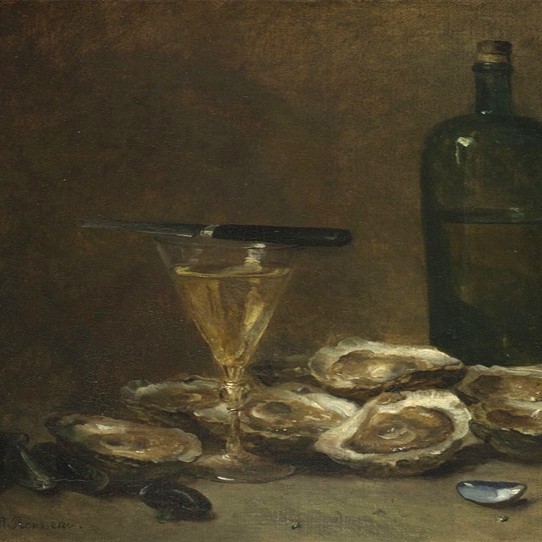
The accompanying image (Still Life with Oysters by Philippe Rousseau, c.1887) serves only as a visual complement to the essay and carries no interpretive or illustrative claim beyond that.
 Allison's Archives
Leave a comment