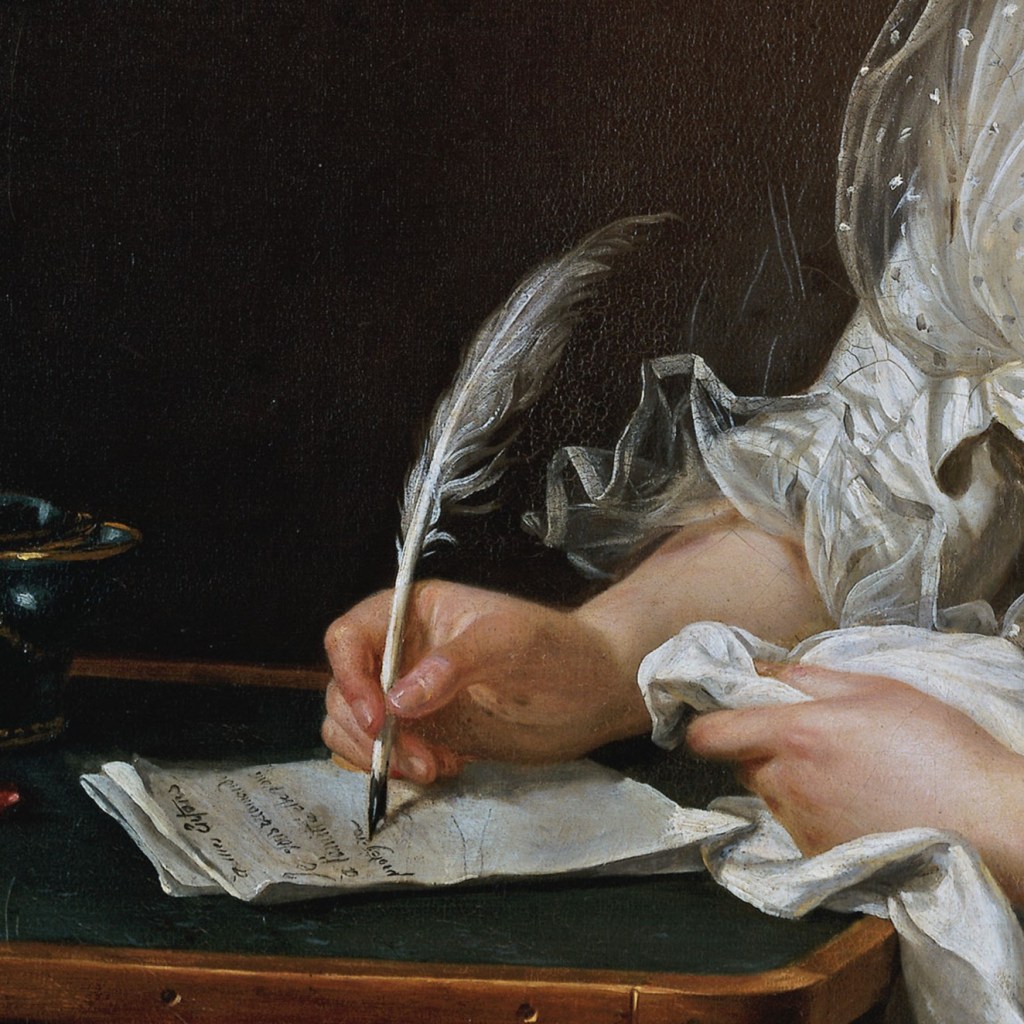
The stubborn disobedience of time has rendered me amnesic when it comes to the contents of my last letter to you. (Pause.) I might remember a small, gnawing detail—whether it is the specific words I had employed or the overall emotion of the writing, I cannot discern. (Sigh.) Nor can I recall how I signed my name. From? Love? With love? Always? On paper and beyond? (Clears throat.) Do you recall? Surely, you don’t. You don’t know what to do with my letters, hence the need for my writing this. (Beat.) How dare I write to you once more. (Clicks pen.) (Clicks pen again.)
Whatever you do, here’s the only thing not to do: Throw away the envelope. Names are the most sacred thing a person can write and you might as well be waltzing with the god of the afterlife if you’re going to toss the envelope into the bin. What is a name if not the very word that affirms your existence? What is an envelope if not a vessel for me to store my words in, but also for you to store your response in—even if it never reaches me?
Now we’ve established what not to do, here’s what to do: The obvious answer is to keep it in a box or burn it, depending on the cajoling forces inside and around you, but mostly depending on how you feel about me (as a person, an idea, a compilation of words). But we do not pray at the altar of obviousness here. I can no longer offer you more letters, but I can offer up a platter of what you could do with those already in your possession:
Bury the letter in your yard, preferably next to the root of a tree. To have the truth of yesteryear so close yet so inaccessible to you, that if you wanted to hold it once more—so to be reminded that what had happened was not just a figment of your imagination—you’d have to get your hands dirty. Mine are stained with ink. Yours might not necessarily be dirt; there are myriad options that can be more permanent.
Remember how much you like to smoke? Roll the letter into a cigarette and inhale it under a red moon. Go on, I promise I’ll find it impressive this time. I won’t be repulsed. Take in every word you couldn’t believe. Let your body do the work instead of your head. See if there’s something addictive inside that makes you come back for seconds. See how painful the withdrawal can be when you realize there are no more seconds.
Soak it in tea if you must. Steep the lines and the curves. Let the parchment turn soft and dissolve like memory—bitter, warm, and strangely comforting. Watch as the ink dissolves and blesses your teacup with the same grey you painted my skies. Then drink it while it is steaming hot so the words sear into your throat and you might understand how choking it was to keep them in mine. Biscuits optional.
Sew it into the lining of your autumn coat. The left side, where it’s closer to your heart. Let it travel with you in silence. Let it keep you warm without anyone knowing. Let it weather seasons of all kinds. Soon, you’ll forget about it. But at least it’ll always be safe. Better forgotten and safe than discarded intentionally. At least you’ll finally own something that stays the same through the seasons.
Let your tears fall generously and deliberately on the letter until the words swirl into each other and are no longer legible. Keep going until you yourself no longer remember its original contents. But watch closely, will you? Some things are only revealed in saltwater. Some truths can only be unraveled through sadness and grief. I wouldn’t allow you to read me so easily without putting in some kind of work, without some kind of sacrifice.
I think you should tell the birds near the fountain about the letter. Whistle the paragraphs, if you wish, until the birds depart. That’s how you know it’s been understood. If they sing it back to you next season, that’s how you know you’ve been forgiven. Some words lie safest in beaks, in vessels that know when to migrate without looking back.
Fold the letter carefully—edge to edge, crease by crease—into the shape of a key. Try it on every lock you come across sans shame or guilt. Never mind the passersby because they will never understand. You will fail so many times but do not let mere statistics get you down. Some doors don’t open with metal. Some doors are made of memories.
Bust out your father’s old paper shredder from the attic and slide the letter through until they are more celebratory confetti than parchment of gloom. Strand by strand, let the fragments float down into a pillowcase. Keep a careful eye out for words that have been shredded in half. Don’t forget to fluff the pillow when you’re done. Rest your head. See if it brings you comfort. If you toss and turn at night, whose fault is it?
Translate it into morse code. The only translation of my writing in which nothing can be lost. Pick the darkest of nights and pack a blanket. Head to the least lit part of your city. Make sure there is no one else around to witness your ritual. Blink your translation at the stars. Perhaps the constellations will listen. Perhaps they already knew. Perhaps they will rearrange themselves to send you back a message. We can hope they will grant you a wish you so desperately need.
Cast it out to the pasture and wait for a goat to amble over. Watch it nose the crumpled paper as if weighing the contents’ worth. With solemn grace, it will take the paper between its teeth, the chewing and crinkling the only sound for miles. Observe which parts are uneaten. That’s the part of the truth that even nature refuses to digest. Can you prove superior?
Feed the letter into the cash slot of a gas station vending machine. The one whose items look like they’ve been locked behind glass beyond their expiry dates. You might want to straighten the letter out so it is accepted. Try wrangling it gently while muttering a prayer under your breath if the first try doesn’t work. It’ll be swallowed eventually. Wait to see what clatters to the bottom of the machine. Not everything you put in gives back what you expect.
Mail them back to me if you must. If it pains you to keep them and if it pains you to destroy them. I’ll do all of the above and let you know if what I had initially written is no longer true. Keep your eye out for stars and silent birds, for non-chewing goats and broken vending machines.
The last thing you can do is to read it again. Because you haven’t looked at it in ages. But there are some parts that remain true. Every word I have written means the same now as when it was initially penned. Just because it is no longer my truth today doesn’t mean it can’t be yours—doesn’t mean it wasn’t mine at some point in time. Whoever said that truth has to withstand the cruelty of time?
Do what you please. Do all of it. Do none of it. Do the obvious if you must disappoint me. What I will do is simply never write your name once more.
SUBSCRIBE TO BE NOTIFIED OF NEW WRITING
The accompanying image (Portrait of a Woman by Adélaïde Labille-Guiard, c.1787) serves only as a visual complement to the essay and carries no interpretive or illustrative claim beyond that.
 Allison's Archives
Leave a comment