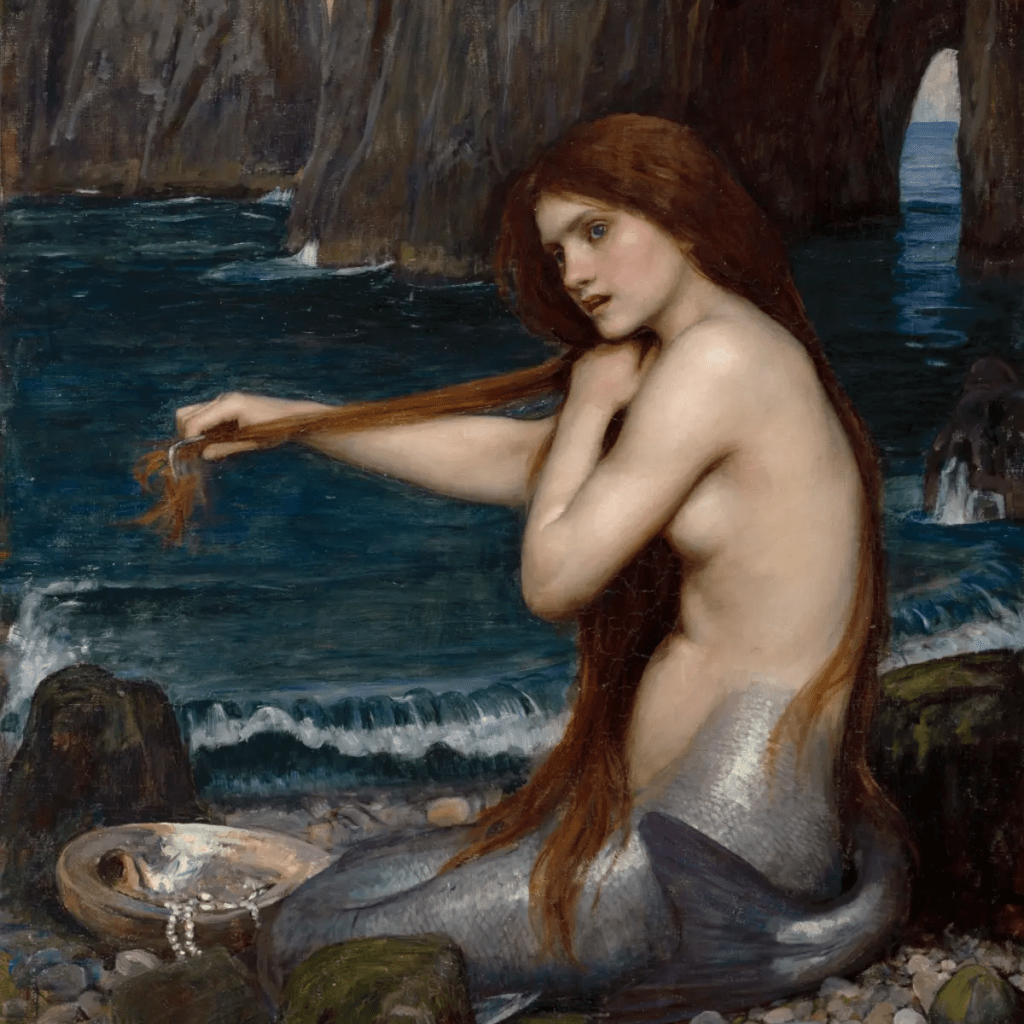
We begin with two questions—Where on god’s green earth did you come across a mermaid, and why are you interested in eating one?—and a confession—this essay is miles away from having anything to do with the consumption of oceanic mythical creatures, I just happen to pray religiously at the altar of allegories.
You’re now wondering what eating a mermaid could be an allegory for. Who am I to refuse you the answer? I believe that if I eat the mermaid, I’ll live in the folds of a moment forever and there would be no urgency to move on. You’re thinking that it’s impossible, but can you blame a girl for trying?
My nostalgia is not an infliction; it’s a self-destructive weapon that I summon and wield at my own will. I’ll flick through photographs and shuffle old playlists until a bittersweet taste knocks on the walls of my heart and drives its way through like a stake. I’ll torture myself with the past until it converts itself into some kind of motivation for me to create a better future—which sounds like a one-and-done job but is, in fact, a vicious cycle. Frankly, I fear that a shared memory will have been forgotten by those who are involved, and see it as my sole responsibility to keep it alive even to my detriment. A modern-day tale of Sisyphus.
The mermaid sits shimmering on my plate. Her tail swishes lightly and her scales glimmer under the sunlight. She’s been out of the water for long enough and should return. The fact that she cannot return has rendered her helpless and resigned. This is the perfect opportunity for me to begin my feast. I don’t want to do it but I have to keep the memory alive. I can’t do it but I still have to keep the memory alive. She has surrendered her fate; the challenge no longer lies in catching her or persuading her to be consumed. The challenge lies in my consumption. I have done this a hundred times and yet I still don’t know where to start.
My hard drive is the most torturous thing to look at in my room, yet it is also my most prized possession. I plug it into my computer and there are the yellow folder icons lined up neatly, all numbered and named, all chronologically organized. I know exactly where every memory sits. I know which faces belong in which subfolder. I know the date of every flagship and birthday. I often wish I existed in an analog age so any photograph I own would be a physical copy. That way, I can take a Sharpie to the faces I no longer wish to keep in my life. That way, I could take a pair of scissors and have a hole take the place of a head. I know I can delete a digital photograph. But I can just as easily fish it out of the bin.
While decluttering my hard drive—which was what sparked this essay—I was also listening to music and subsequently made the executive decision that my Spotify, too, could use some filtering. I sat on my bedroom floor only to realize just how many shared playlists I have with my friends. Had with my friends? Some who are still friends, some who can no longer call themselves that? Whatever the politically correct term, you understand the point I’m trying to convey. Every mix was created at a specific time in my life: A car playlist for lunch drives during college. A playlist made for me when I was boarding my first flight to Manchester. A shared playlist with my long-distance friends. A playlist for when I had to begrudgingly take the tube during my London internship. A playlist tailored for me to fall asleep to. It’s not necessarily the songs that make up the memory; it’s the feeling the collective tracks imbue in me. Unlike the photographs, however, it was easier to delete certain playlists. I suspect this is because I don’t want to have to listen to a song and pin it to a memory; I’d like to be able to listen to the music I enjoy simply because I like it. Photographs, on the other hand, are fundamentally attached to memories. And so with a click here and another one there—a handful of playlists unlatched themselves from my profile.
I start by marinating the mermaid generously in what-ifs and if-onlys. Then, I fix her up over a fire fueled by the narratives that I have weaved and the pictures that I have painted. While that is going on, I fill up the wait by setting the table for three: myself, the blame, and the grief. I arrange the soft parts of my past and my missteps into a centrepiece and keep twisting the angle until I get it right. Until I get it right this time. I polish the silverware until it is flawless then pour an appropriate glass of melancholy. Two candles or three to add—not for the ambiance, for this is a vigil. Before I sink in my seat, I draw the blinds; this is not a meal to be witnessed lest someone bursts in offering help and mantras that are destined to fail.
I don’t use Facebook anymore. The app simply sits in a folder on my phone as an icon because I hate any kind of change to my home screen. I hate any kind of change. But Facebook also happens to be where my once-were friends live. So, occasionally, putting my legs up on the desk of the cat curiosity had yet to kill, I tap the big, white f icon and allow myself a decent number of scrolls, usually until my jaw unhinges itself. One such instance was when my screen flashed a collection of wedding photographs before me and it took a second for me to register that an old friend from primary school had exchanged vows with the love of his life at the altar.
Life events like these often catch me off guard like being stung by a sea urchin because I often assume the position that a person I know is forever stuck in the circumstance in which I last saw them, frozen in time and place. Let there be no ageing of features or maturing of words or encounter of new experiences, for I so heavily value the relationships that I have that I cannot fathom not being a witness to new growths. In the back of my mind, I know this mindset needs refining and I promise I’m working on it, but it’s hard to ride a linear progress when no one else hears the mermaid’s siren song the way I do.
A closer friend of mine told me to expect her engagement and possibly wedding within the next three years and I thought, Hold up, I haven’t saved up enough money for a Reformation dress or a plane ticket. Really, I was begging for more time to process this information because last I checked, we were just in IGCSE Physics tuition class together, scratching our heads trying to make sense of an equation. Last I checked, it was only yesterday when the biggest question on our minds was what to have for lunch. Last I checked, I was still kissing my crescent IKEA nightlight goodnight.
I hold my nostalgia close to my chest and breathe it in like it’s my only source of clean air. Moving on is too manual of a task. I have to find the memory and play fetch with it a couple hundred times before I decide whether I want to move on from it—and more often than not, I don’t want to because how am I meant to part ways with something that has led me to where I am today? Even when I do decide it’s time to let go, there’s the tedious methodology—because moving on from a person, a place, and an emotion all require varying strategies; there is no one-size-fits-all guide to moving on. Everything you try to move on from traps you in a different way; some are mousetraps, others are Saw traps.
Even when we move on, the memory doesn’t. It stays in the same spot in case you turn your head and look back. Not necessarily longingly, but just to assure yourself that it happened; because as much as we are the product of what others did to us, we are also what we do to ourselves. So there will continue to be songs that I cannot listen to but keep in a playlist, photographs I cannot look too long at but refuse to bin; thankfully it is the marvelous truth of our universe that there is a never-ending supply of songs for me to dip my toes into and that I can always take new photographs. And maybe the best way to move on is not to stir the still waters of the past but to let the present gently drift forward until old memories sink to the bottom of the blue.
The timer rings and dinner is served. I cut a piece of the fantasy that I can stay here forever and hold it up to my mouth. It smells like if I hold on tight enough, I can reverse time. It smells like this meal can nourish me indefinitely. But I let the silverware fall and I part the curtains. I let the mermaid go (surprisingly, she’s still kicking).
It was never about devouring the creature; it has always been about accepting that she never belonged on my plate in the first place. Who named me keeper of the memory? Who named me kindler of the flame? Though it may not always be smart to blindly mirror the actions of others, when it comes to memories, I can’t be the only person upholding it. She has always belonged to another world, and I was only ever a visitor.
And so she drags herself back onto the shore and exerts her last energy in dipping herself back in the waters. She swims so far away from me that I start to forget what she looks like. She swims so far away from me that all that’s left are the dying ripples near the shore. She swims so far away that I remember I can swim too.
The sea is quiet. My plate is empty. And my hands are clean.
SUBSCRIBE TO BE NOTIFIED OF NEW WRITING
The accompanying image (A Mermaid by John William Waterhouse, 1900) serves only as a visual complement to the essay and carries no interpretive or illustrative claim beyond that.
 Allison's Archives
Leave a comment