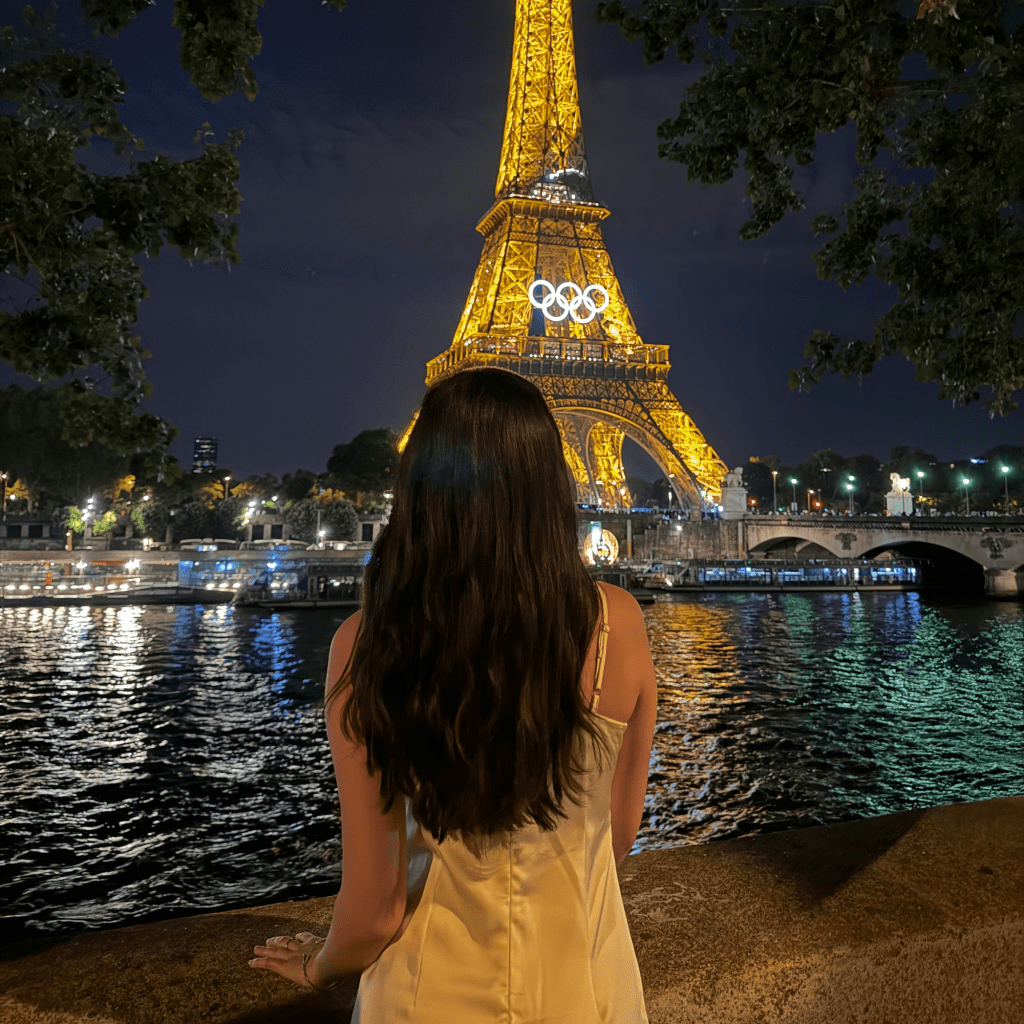
The height of summer was not yet made conscious to the world, yet the sun reigned supreme above us, entrenching the coach in a kind of suffocation without timely reprieve. The Eurostar chugged steadily across the channel against the backdrop of murmurs. The soft vowels and back-of-throat rolling of r’s served as a constant reminder of where I was headed. The air was laced to the brim with unfamiliarity once again, but unlike during my Italian voyage, I could make reasonable sense of this foreign language. When we emerged from the other end, the clocks had already adjusted forward by an hour—I should’ve taken that as a sign of how quickly this trip would pass me by.
I slammed the cab trunk down outside of Gare du Nord and clambered with all the elegance of a wet lettuce into the seat. There was no doubt about it—I stood out starkly as a tourist and the cab driver knew, allowing himself a little smirk before he indulged in cheery conversation.
He: Is this your first time here?
Me: Oui, c’est ma première fois en France.
I would be hung a liar if I said this trip was not opportune for me to practice two years’ worth of French.
He: Ah, mais non! Paris n’est pas la France. Paris, c’est Paris!
Me, laughing: D’accord.
Whether he took the scenic route to give me a preliminary introduction to several landmarks or whether that was the designated path on the GPS, the cab driver navigated through the busy avenues of Paris and I nearly stuck my face up against the window to take in the Arc de Triomphe and Eiffel Tower in all their glory. It was like singling out a pen pal in a crowd—someone you have heard so terribly much about and are finally meeting for the first time. Through the rolled-down windows, we sped past Parisians who appeared equal parts sanguine and poignant, surrounded by smoke and alcohol on an ordinary Tuesday night. Quietly, I arrived, and they couldn’t care less.
It clicked for me immediately what the cab driver had been implying; for Paris was not just another European city, it was a world of its own. I felt as though I was in a movie, thinking This is what Audrey Hepburn’s Sabrina must have felt like when she left her home to pursue culinary arts in Paris! There was a surge of exhilaration that I could not quell in that backseat; I longed to set fire to every Paris postcard I have ever collected, to scream that I no longer needed prints now that I was there to physically carve the city into the insides of my eyelids.
As we drove down Champs-Élysées, I attempted ever so desperately to remain objective in my observations, to not let my fifteen-year-old dream of visiting Paris cloud my judgment with rose tints. Everyone I have ever spoken with has had only terrible things to say about Paris. The rubbish, the rats, the intolerance. That the city would not be what I dream it to be. But I have not yet once dreamed so ambitiously as to disappoint myself. In my humble opinion, it is not I but they who stand corrected, for Paris was everything I had architected in my head and so much more.
Night had befallen Paris by the time I had checked into my accommodation, the streets nary a sound save the occasional whispers of passersby. Morpheus cradled me softly and I smiled knowing where I would wake up come the morrow.

Paris makes an artist out of everyone, so long as one allows it. I maintain that one need not have endured an art history degree or have a keen eye for the finer details to appreciate art. Great art is not one that stands you in front of it for long, rather, great art should either make you want to live greedily as an immortal or it should make you want to die in utter pain and despair before the canvas. There is no in-between. Art does not exist in between, it exists loudly, insists on taking up space, and so should we.
If we are not careful, we just might mistake the Louvre for a body that stores a host of artworks within, forsaking that itself, rightfully, is also an artwork, if not the artwork. Allow me an explanation: While the many paintings and sculptures that pay rent in the Louvre are, individually, homages to the respective periods they were created in, the Louvre itself stands as an ode to every period that has glided past since its inception. That time has a funny way of leaving indelible traces is evidenced by the careful existence of the Louvre: From King François’ Renaissance elegance to Louis XIII’s Baroque touches, Napoleon’s Corinthian columns to the modernity of the glass pyramid, each addition has evolved the Louvre from fortress to palace to museum, ultimately a mirror of French history.
If I were to detail every piece that captured my attention, this post would take a year or so before it sees the light of the internet. And so I indulge you with my observation of the three crown jewels of the museum: Venus de Milo, The Winged Victory of Samothrace, and the Mona Lisa herself.
The first I came across was Venus de Milo, who one might so recklessly miss if one does not seek her out intentionally. A beauty ensconced in the hallowed halls of the museum, the Greek sculpture is an art of timeless allure despite its missing arms. Rumor has it that French and Turkish sailors longed for a piece of the artwork and that they were the reason her arms were broken off during a fight. I didn’t quite know what to make of that when I had learned it, never mind fact or fiction. Despite the alleged tragedy, she remains unshaken in her gaze, challenging all who stand before her in an ageless confidence. There is so much chatter around the mystery of her missing arms as if she is deemed imperfect because of that loss, yet we forget that this is a goddess within our midst—that she is meant to be perfect no matter what form she takes on. Let that be a reminder to us—that loss does not dictate your character; rather, it is what you do with the loss that shows your audience who you are.
Let it be known that I do not weep before art. I am touched greatly, yes, as if the sculptors had forced the chisel along the grooves of my neck. I am choked often, yes, as if the artists had forced their paintbrush down the narrows of my throat. But it is unusual that any artist wields the tool to crank up the faucets behind my eyes. Enter The Winged Victory of Samothrace. I attribute the same kind of perfection to this figure of Nike as I did to Venus, but standing before Nike struck a different chord in me. While you could look into Venus’ eyes and directly engage with—and maybe even justify—the source of her pain and perfection (though who is to say both are not synonymous?), there is no window to the soul you could peer into with Nike. So you stare, long and hard from the left three-quarters because that is the most detail you can glean out of this haunting beauty. The absence of Nike’s head and arms, ironically, makes her less broken than ever. Instead of being diminished, the masterful drapery of cloth against her skin and the mid-movement nature of her wings infuse her with more strength than ever. She is more alive in her incompleteness than many sculptures could be in their entirety. Then there is what she stands for, at least what I took away, that is the fleeting nature of victories in life. Glorious! Yes! But also transient and oftentimes leaving us feeling like something is missing. No victory comes without sacrifice. I stood before her—awed, undone.


The lady sits behind glass with the faintest smile as cameras flash from a distance. Every visitor has a quiet conversation with the mysterious muse during opening hours, but she is the furthest thing away from paying attention. What first struck me was just how small the Mona Lisa is. When a piece of work is so deeply ingrained in world culture, I suppose our expectations inflate; fame, after all, is so often unjustly associated with the big and grandeur. And yet it is the modest canvas she is trapped in that makes the entire experience intimate. I made my way to the front of the crowd and the world peeled away almost instantly. There was a sublime woman unbothered by fame, unbothered by the thought of the whole world attempting to decipher her smile. What DaVinci has captured is a fleeting moment, almost the breakage of a smile just before it fully forms, and perhaps Mona Lisa was a woman who knew either how to make the most of fleeting moments or how to let them go. No matter which, there is an art to be learned there.
In their own ways, all three crowned jewels of the Louvre are imperfect in some way—missing limbs, lost head, halfway smile—only the most accurate reflection of the phrase art imitates life. Having been alarmingly reminded of this stoic truth, I exited the Louvre into a Parisian evening.

During my three days in Paris, I managed only to visit one other museum—trust that the selection process was a painstaking one that paralyzed my indecisive self—Musée de l’Orangerie. Soft lights illuminated the pale gallery walls that curved and bent with the grace of Monet’s water lilies. In contrast to the Mona Lisa, Monet’s creations are large and span around the room, engulfing admirers in endless swaths of blue, green, and purple serenity. If you allowed yourself to pretend enough, you could be a water lily too. Good art reminds you of the passage of time—the one thing that every object, living or nonliving, has to sit through—and Monet accomplishes just that with two elements of his series: the lilies and the ripples. The ebbs and flows of surface ripples are a subtle testament to progression, that everything moves on regardless of our preference and grip. The water lilies scattered around the canvases, depicted in various stages of blooming, are evidence of the fluidity of time and growth. While my time in the Louvre was plagued by emotions, Musée de l’Orangerie injected my very veins with questions: How did Monet, whose vision was blurred by cataracts toward the end of his life, capture light and nature sharper than ever? Does our understanding and memory of the world around us grow purely with time or does it have to do with how intently we choose to immerse ourselves in it? What are the water lilies trying to tell us about the impermanence of life, the transience of beauty, the double-edged sword of nature to induce chaos and calm? Or is there nothing to learn, and sometimes we are meant to take art at face value because analysis isn’t a prerequisite to appreciating beauty?
Had I an extra day to spend, you would have caught me on a train to Monet’s abode in Giverny, where I may have gotten all my questions answered. Alas, the incompletion of this visit will only warrant a much-welcomed return soon. How wonderful the world provides us with slabs of marble and references of colors; thank God we did not leave them sitting around.
And if I were to describe Paris in one word, it would be swallowing. Paris swallows you whole and spits you out a different person. So different that you could not even tell what had changed, only the clarity that something had been replaced, like an open-heart surgery without diagnosis or explanation. Speaking of the heart, perhaps I was most disappointed to realize that Paris did not feel very much like the City of Love. In hindsight, however, I don’t think that nickname was attributed in a romantic sense. I think the love is meant to be directed towards life itself, and this realization brought me a great deal of joy that will not soon leave my spine.
Should you ask me for the evidence, well, not a day goes by where I don’t think about the cruise I took along the Seine on that warm summer’s evening. While the iron latticework of the Eiffel Tower risks looking stark and industrial in regular daylight, every rivet and beam glistened in a honeyed, ethereal glow in the golden sunset, as though it was the gateway between heaven and earth. I waited in the barren wind for my cruise, which set sail at ten at night; the queue was dreadful but it paid off when I found a seat near the observation deck, on which I stood for most of the hour.
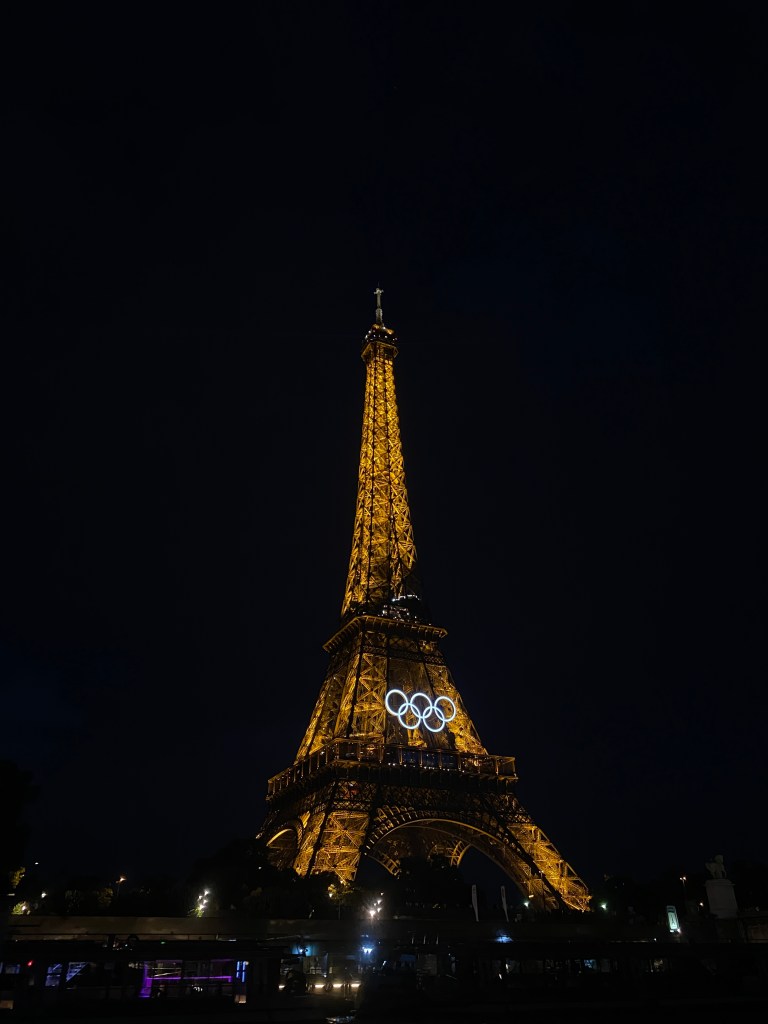
Now, here is where the evidence comes into play. As we cruised along the Seine, the water lapping softly against the boat, an array of happenings unfolded before my eyes. Teenagers sat carefree on rooftops, their legs dangling freely without fear as they hollered and waved at us. Pieces of pastries were broken off and handed between friends lazily perched along the riverbanks after a long day of work. Couples old and new strolled with their heads thrown back, their laughter mingling with the evening breeze that had begun picking up. Music and the aroma of dinner seeped from arrondissements into the Seine, where breathtaking vignettes of life congregated. The city’s landmarks rose and fell in a gentle parade as the sky’s golden hues bled into ebony when we did a turn next to Notre Dame. And can’t you see? It’s in the silent conversations that spill from a late-night bistro, the way Parisians savor every sip of wine, every bite of bread, and the casting of every elegant shadow. It’s the art that lives beyond museums, on street corners, in jardins, over bridges, and in the waters. Love here is more than an affair of romance—it is an affair of life, of simply being without reason or rhyme.
Fill my pockets with stone and let me walk into the Seine! I’ll drown and come back to tell you what it is like to be in love with life.
There is Paris in daylight and Paris at night. Paris in the sun is a woman who stands on business but never frazzles as she quickens her pace in her Louboutins to catch the metro. She clicks her heels like she clicks her lipstick case like she clicks her phone. Paris at night lets her hair down and fashions a silk curtain into a last-minute cocktail dress and balances her heels by her fingertips long after bars have closed.
Then there is Paris on a Saturday morning, just before noon grows too glaring. Paris, during this very specific window of time, concentrates sweetly at Café de Flore, where the outside world collapses. To understand my obsession with the Café, you need to understand that while wars rained on in the early 1900s, individuals who would emerge as forward-thinkers of a great generation found sanctuary under the crisp white marquees of the Café, where their ideas and outlook on life propagated over a steaming pot of coffee.
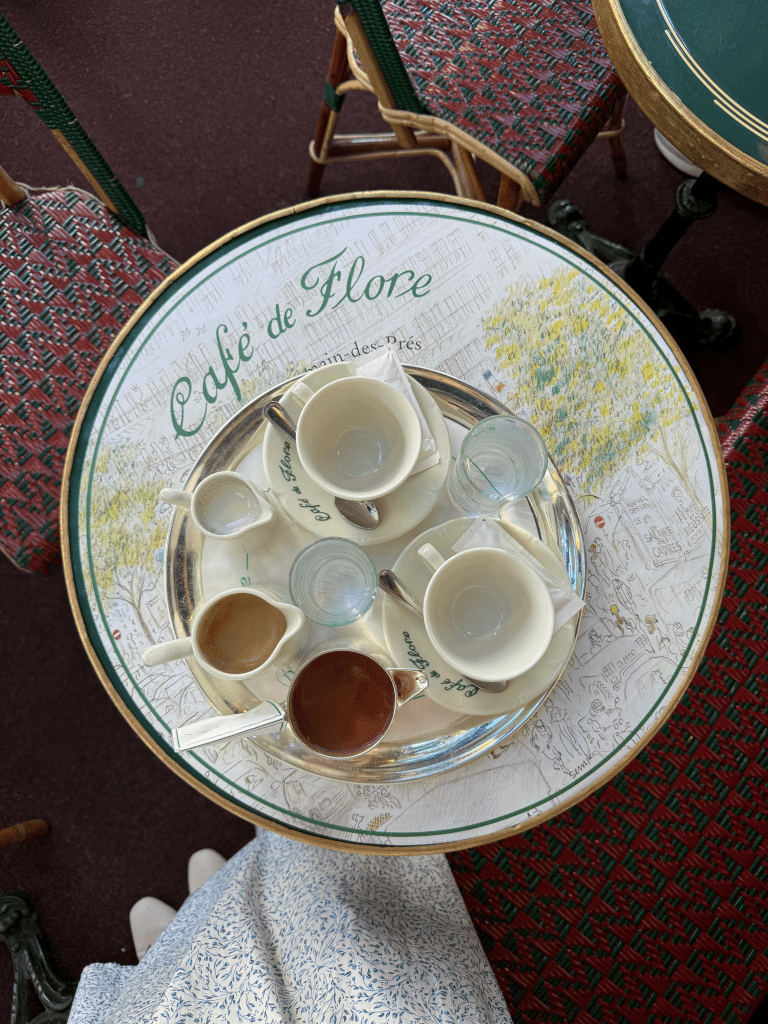
While I am the furthest thing from the likes of those great minds, I, too, sat at the Café’s iconic small round tables with my notebook in hand, wondering if the musings of the greats were ever absorbed by the worn red leather banquettes and art deco mirrors. Was every delicate clink of cups an echo of an idea produced in this haven? Did time stretch long and lazy to allow for hours of senseless observation and contemplation of life as the rest of the world passed by? As the coffee grows cold, one reflects, one creates, and one becomes—the Café itself a conduit for inspiration.
Perhaps it is my affinity for writing that makes Paris all the more attractive for I have long read about authors, specifically, who take their seats to people-watch with nothing but a pen and notebook until they decipher some kind of magic from the mundane to be jotted furiously. How many works of Descartes, de Beauvoir, Coppola, Tarantino, Saint Laurent, Camus, Hemingway, Baldwin, and the rest were birthed right here? And, perhaps!—it isn’t that there is much writing inspiration to be gleaned from the city, but that the city writes itself. But ah, who’s to know? That is a question to mull over with some pastries and coffee at Café de Flore.
The height of summer was not yet made conscious to the world, yet the sun reigned supreme above us, entrenching the coach in a kind of suffocation without timely reprieve. The Eurostar chugged steadily across the channel against the backdrop of murmurs. The soft vowels and back-of-throat rolling of r’s served as a constant reminder of where I was returning from. When we emerged from the other end, the clocks had already adjusted backward by an hour—I should’ve taken that as a sign of how quickly this trip had passed me by.
Oh! I fear my lust for life is hemorrhaging into the Seine. Paris, bleed me dry; Paris, take me back.
 Allison's Archives
Leave a comment